

Updated: 2024-05-15 (Note: Date will be dynamically generated in the actual publication environment.)
Content that resonates with your audience often comes down to clarity. If your message is buried in jargon, overly complex sentences, or simply hard to follow, even the best ideas can fall flat. This is where AI-powered readability checks come in, offering a smart way to refine your writing and ensure it hits the mark every time.
Think about the last time you read something that just flowed effortlessly. Chances are, the author had a strong grasp of readability, even if they were not consciously thinking about Flesch-Kincaid scores. AI tools now bring that level of analytical insight to everyone, helping you identify areas where your content might be tripping up your readers.
Why Readability Matters for Your Business Content
It's not just about avoiding big words. Readability impacts everything from conversion rates on your landing pages to the engagement levels of your blog posts and the clarity of your customer support documentation. When your content is easy to digest, your audience is more likely to stay on the page, understand your message, and take the desired action. Research from the National Center for Education Statistics (NCES) consistently shows that readability directly correlates with comprehension, particularly in educational contexts, and the U.S. General Services Administration (GSA) highlights that clear communication can significantly improve public engagement and reduce costs across government services.
Factors like sentence length, paragraph structure, word choice, and even the active or passive voice can all influence how readable your text is. Ignoring these can lead to higher bounce rates, lower time on page, and ultimately, missed opportunities. For instance, the U.S. Department of Health and Human Services (HHS) emphasizes clear communication for health literacy, a principle applicable to all fields and crucial for ensuring public understanding of vital information.
"Clear writing is clear thinking. AI helps us see where our thinking might be getting muddled on the page."

Tools and Techniques for AI-Powered Readability Checks
Many AI writing assistants and dedicated readability checkers can help you analyze your content. Tools like Grammarly, ProWritingAid, and even some features within Notion AI or advanced generative AI models like ChatGPT and Google Gemini can provide valuable feedback. The National Institute of Standards and Technology (NIST) recognizes the growing role of AI in language processing, highlighting its potential for enhancing communication and trustworthiness, while also emphasizing responsible development.
Here's a step-by-step approach:
- Draft Your Content: Write your initial draft as usual, focusing on getting your ideas down.
- Run a Readability Scan: Paste your content into your chosen AI tool. Look for specific metrics like Flesch-Kincaid grade level, Gunning Fog index, or Dale-Chall readability score. These metrics are widely used in fields from education to government, as documented by resources from the U.S. Department of Education (ED) which now actively explores AI applications to improve educational outcomes.
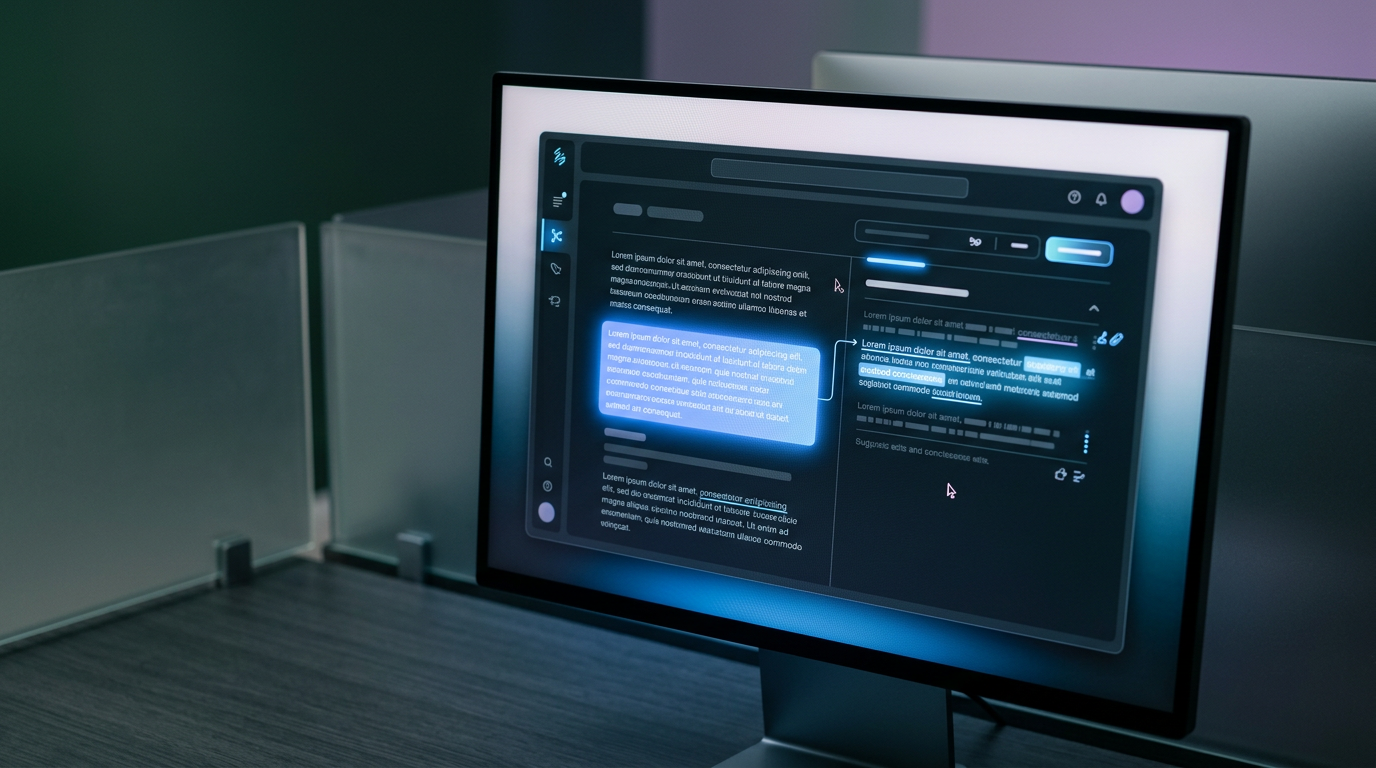
- Review Suggested Improvements: The AI will often highlight long sentences, complex words, or instances of passive voice. Pay attention to these suggestions.
- Simplify and Clarify: Actively rewrite sentences to be shorter and more direct. Replace jargon with simpler alternatives. Break up lengthy paragraphs.
- Check for Active Voice: Most AI tools can flag passive constructions. Rewriting in active voice often makes your prose more dynamic and engaging. This aligns with guidelines from the U.S. Government Publishing Office (GPO) Style Manual, which advocates for clear and direct language in all government publications.
- Read Aloud: This old trick still works wonders. Hearing your words can help you catch awkward phrasing the AI might miss.
Prompt Example for ChatGPT or Gemini
When using a large language model like ChatGPT or Gemini, you can be very specific with your requests:
''' Review the following text for readability. Provide the Flesch-Kincaid grade level, and then suggest five specific areas for improvement, focusing on sentence length, word choice, and use of active voice. Rewrite three sentences to demonstrate how to make them clearer and more concise.
[PASTE YOUR CONTENT HERE] '''
Integrating Readability Checks into Your Workflow
Making readability a standard part of your content workflow doesn't have to be time-consuming. It's about building a habit.
- Pre-Publication Checklist: Add "run readability check" to your final content review checklist.
- Early-Stage Integration: For longer pieces, use AI tools during the editing phase, not just at the very end.
- Team Training: If you have a content team, encourage everyone to understand and apply readability principles, using AI tools as their assistant. The U.S. Office of Management and Budget (OMB) emphasizes the importance of clear communication in all government documents and now also guides the responsible use of AI across federal agencies, a principle that can guide internal team training on content creation.
By consistently applying AI-powered readability checks, you're not just making your content easier to read; you're making it more effective, persuasive, and ultimately, more successful for your business.
Frequently Asked Questions
What is a good readability score for web content?
A "good" score varies by audience, but generally aim for a Flesch-Kincaid grade level of 7 to 9 for broad web content, as recommended by various communication experts and observed in successful online content. Simpler content for wider audiences might target 6 or lower, aligning with guidelines often used for public-facing information by agencies like the Centers for Disease Control and Prevention (CDC) for their health communication materials.
Can AI tools perfectly assess readability?
AI tools are excellent assistants, but they don't replace human judgment. They provide data and suggestions; you still need to apply editorial discretion for nuance and context. The evolving nature of AI in language is a topic of ongoing research by institutions like the National Science Foundation (NSF), which funds advancements in AI and natural language processing to enhance human capabilities.
How often should I check my content for readability?
Ideally, all new content should pass a readability check before publication. For evergreen content, consider rechecking it periodically as part of a content audit to ensure it remains current and accessible. This practice is akin to regular content reviews conducted by government agencies to maintain information accuracy and clarity, as suggested by the U.S. General Services Administration (GSA) for effective digital content management and user experience.